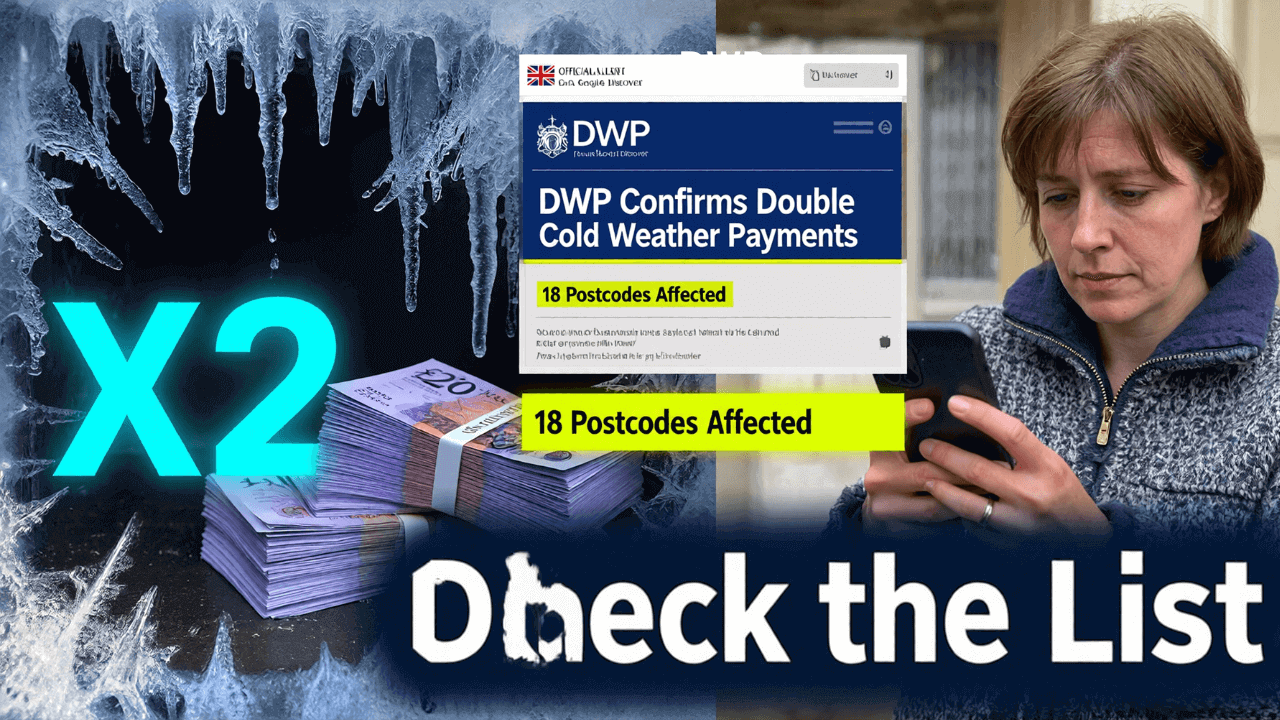
Cold weather brings more than frost and snow. For many households across the UK, especially pensioners and low‑income families, freezing temperatures also mean higher heating bills and difficult financial choices. That is why the Cold Weather Payment scheme exists — and why recent confirmation of double payments in 18 postcodes has drawn widespread attention.
The Department for Work and Pensions has confirmed that unusually severe conditions have triggered multiple Cold Weather Payments in a limited number of areas. For eligible households, this means extra support at a time when energy costs remain a serious concern.
This article explains what double Cold Weather Payments mean, why some postcodes receive more than one payment, who qualifies, and what people should do next.
What Cold Weather Payments are designed to do
Cold Weather Payments are automatic payments intended to help vulnerable households cope with extra heating costs during severe winter weather.
They are paid when:
- Temperatures drop below a specific level
- Cold conditions last for a set period
- A household meets benefit eligibility rules
The scheme is not something people usually apply for — it is triggered automatically.
What “double payments” actually mean
A double Cold Weather Payment does not mean a special bonus or new scheme.
It happens when:
- Two separate cold periods are officially recorded
- Each cold period meets the qualifying criteria
- Payments are triggered more than once
Each qualifying period results in a separate payment.
How much a Cold Weather Payment is worth
Each Cold Weather Payment is £25 per qualifying cold spell.
This means:
- One qualifying period = £25
- Two qualifying periods = £50
- Payments can add up if conditions persist
For households on tight budgets, this extra support can make a meaningful difference.
Why only 18 postcodes are affected
Weather conditions vary significantly across the UK.
The 18 postcodes confirmed for double payments experienced:
- Sustained sub‑zero temperatures
- Longer cold spells than surrounding areas
- Conditions that met official weather thresholds more than once
Other areas may still qualify later if conditions worsen.
How cold spells are officially measured
The system relies on data from local weather stations.
A payment is triggered when:
- The average temperature is 0°C or below
- This lasts for seven consecutive days
- The measurement applies to a specific postcode area
This prevents payments being issued based on short or isolated cold snaps.
Why payments are postcode‑specific
Cold Weather Payments are not issued nationwide at the same time.
Instead:
- The UK is divided into weather station areas
- Each station covers multiple postcodes
- Payments are triggered locally, not nationally
This ensures support reflects actual conditions on the ground.
Who qualifies for Cold Weather Payments
Eligibility depends on receiving certain benefits.
These include:
- Pension Credit
- Universal Credit (with specific conditions)
- Income Support
- Income‑based Jobseeker’s Allowance
- Income‑related Employment and Support Allowance
Not everyone on these benefits qualifies automatically.
Pensioners and Cold Weather Payments
Pensioners are among the most affected by winter costs.
Those receiving Pension Credit may qualify automatically when:
- Cold conditions are confirmed
- Their postcode falls within a trigger area
No application is required in most cases.
Families and vulnerable households
Some families with children may also qualify.
This applies when:
- Universal Credit includes additional elements
- A child under five is present
- Health or disability conditions apply
Eligibility rules can be complex.
Why some people miss payments
Missing payments usually happen because:
- The household is not eligible
- The postcode does not meet temperature thresholds
- Benefit details are outdated
It is rarely due to an error once eligibility is confirmed.
How payments are made
Cold Weather Payments are paid:
- Automatically
- Directly into the same account as benefits
- Usually within 14 working days
There is no separate claim form.
What to do if a payment does not arrive
If a payment is expected but not received:
- Check benefit eligibility
- Confirm the postcode qualifies
- Contact the relevant benefit office
Delays can occur during high‑volume periods.
Why double payments matter this winter
This winter has seen:
- Higher energy prices
- Increased reliance on heating
- Greater financial pressure on fixed incomes
Double payments reflect the severity of conditions in certain areas.
How Cold Weather Payments differ from Winter Fuel Payments
The two schemes are often confused.
Cold Weather Payments:
- Are triggered by temperature
- Can happen multiple times in a winter
Winter Fuel Payments:
- Are annual
- Are age‑based
- Are paid regardless of weather
Some households receive both.
The role of energy costs
Even with support, heating remains expensive.
Many households report:
- Using heating less often
- Heating only one room
- Choosing between warmth and other essentials
Cold Weather Payments are designed to reduce this pressure, not eliminate it.
Why the number of postcodes is limited
Only areas meeting strict criteria qualify.
This avoids:
- Paying for mild conditions
- Wasting public funds
- Triggering unnecessary payments
The downside is that nearby areas may feel unfairly excluded.
How often Cold Weather Payments can be triggered
There is no official limit.
Payments can be triggered:
- Multiple times in one winter
- As often as cold periods meet criteria
This is why “double payments” are possible.
Public reaction to the announcement
Reaction has been mixed.
Some welcome:
- Extra support during extreme cold
Others question:
- Why nearby areas miss out
- Whether thresholds are too strict
The debate returns every winter.
How the DWP communicates triggers
The DWP publishes:
- Lists of affected postcode areas
- Updates during cold spells
However, many people learn about payments only after they arrive.
Why awareness is still low
Many eligible households:
- Do not know the scheme exists
- Assume they must apply
- Do not check postcode triggers
This leads to confusion and missed expectations.
What households should do now
Households should:
- Check whether their postcode qualifies
- Ensure benefit details are up to date
- Monitor bank accounts during cold periods
No application is needed if eligible.
What happens if temperatures rise again
Payments stop once:
- Temperatures rise above the threshold
- A qualifying cold period ends
There is no repayment requirement.
The wider cost‑of‑living context
Cold Weather Payments are one part of wider support.
They sit alongside:
- Winter Fuel Payments
- Cost‑of‑living support measures
- Energy bill assistance
Each addresses different pressures.
Why accurate reporting matters
Misleading headlines can cause problems.
People may:
- Expect payments they are not entitled to
- Delay budgeting decisions
- Experience unnecessary stress
Clear information helps households plan.
Could more postcodes be added later
Yes.
If further cold spells occur:
- Additional postcodes may qualify
- New payments may be triggered
Eligibility is reviewed continuously during winter.
Why severe weather is becoming unpredictable
Weather patterns are less stable.
This means:
- Sudden cold snaps
- Uneven regional impact
- Difficulty predicting payments
Flexibility is built into the system for this reason.
How Cold Weather Payments are funded
Payments are funded through:
- Central government
- Existing social security budgets
They are treated as emergency support, not permanent income.
What support experts say
Support organisations stress:
- The importance of checking eligibility
- Not relying on one form of support alone
- Seeking advice if struggling
Cold Weather Payments are helpful but limited.
Key points to remember
- Double payments mean two cold spells
- Each payment is £25
- Only specific postcodes qualify
- Payments are automatic if eligible
- More areas may qualify later
Final thoughts
The confirmation of double Cold Weather Payments for 18 postcodes highlights just how severe winter conditions have been in some parts of the UK. For eligible households, the extra support offers welcome relief during a period of rising energy costs and financial strain.
However, the scheme remains tightly targeted and dependent on precise weather data. Households should stay informed, check eligibility carefully, and avoid relying on headlines alone. Cold Weather Payments are designed to respond to genuine need — and when the cold bites hard enough, they can arrive more than once.