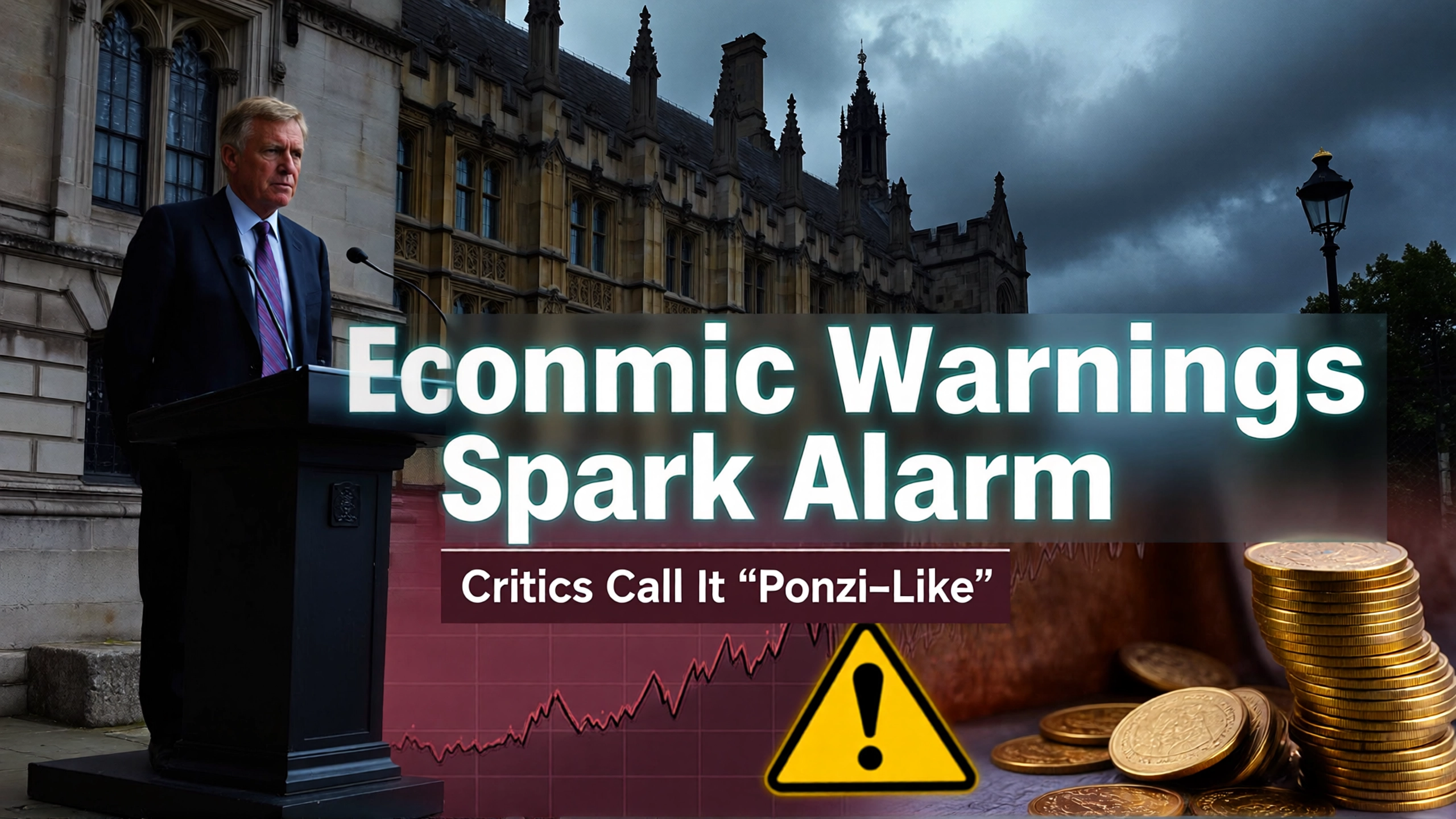
UK politics is no stranger to sharp language, but the recent “Ponzi-like” warning aimed at Labour’s economic plans has pushed the debate into far more heated territory. At the centre of the storm is Rachel Reeves, whose approach to borrowing, public spending, and long-term fiscal stability is now facing intense scrutiny from economists, opposition figures, and sections of the financial press.
Supporters say the criticism is exaggerated and politically motivated. Critics argue the warnings highlight real risks that could hit taxpayers hard if ignored. As the row escalates, many UK households are left asking a simple question: is this just Westminster noise, or a genuine red flag for the economy?
Why the ‘Ponzi-Like’ Claim Is Causing Such Uproar
The phrase “Ponzi-like” is explosive in economic debate. It implies a system that relies on constant new money to sustain existing commitments — something no government wants associated with its plans.
Critics argue that some of Labour’s proposed funding strategies risk leaning too heavily on future growth assumptions. They claim this creates a cycle where today’s promises depend on tomorrow’s borrowing, leaving little room for error if economic conditions worsen.
Supporters counter that the comparison is misleading and deliberately alarmist. They insist the plans are rooted in responsible fiscal management, not speculative financing, and accuse opponents of using fear-based rhetoric to score political points.
What Rachel Reeves Has Actually Promised
At the heart of the debate is a pledge to balance economic credibility with social investment. Reeves has repeatedly stated that Labour would not engage in “reckless spending” and would operate within clear fiscal rules.
These include commitments to stabilise debt over the medium term and ensure day-to-day public spending is funded through taxation rather than borrowing. On paper, these rules are designed to reassure markets while still allowing room for investment in areas such as infrastructure, green energy, and public services.
However, critics argue that the scale of ambition does not match the available funding without significant borrowing or future tax rises.
Why Economists Are Split
Economic experts are far from united on the issue. Some economists say the warnings are overblown, noting that many advanced economies rely on borrowing to fund growth-enhancing investment.
They argue that comparing public investment to a Ponzi scheme misunderstands how sovereign debt works, especially in a country with its own currency and strong institutional framework.
Others take a more cautious view. They warn that rising interest rates and global uncertainty mean borrowing carries greater risk than it did a decade ago. If growth underperforms, debt servicing costs could crowd out spending on essential services.
The Market Confidence Question
One of the most sensitive aspects of the debate is how financial markets might react. The UK’s experience following the 2022 mini-budget still looms large in political memory.
Critics say any perception of unrealistic funding could spook investors, pushing up borrowing costs for the government — costs that ultimately fall on taxpayers.
Labour figures argue that Reeves’ emphasis on fiscal discipline is precisely designed to avoid such scenarios. They point to her repeated engagement with business leaders and financial institutions as evidence of a credibility-first approach.
Political Motives Behind the Language
Some Labour supporters believe the “Ponzi-like” label is less about economics and more about political positioning. They argue it is designed to undermine trust before voters have a chance to examine the details.
The language, they say, simplifies complex fiscal debates into soundbites that generate headlines but shed little light on the real choices facing the country.
Opponents respond that tough language is justified when public finances are at stake, and that voters deserve blunt warnings rather than carefully massaged reassurances.
What This Means for Ordinary UK Households
For most people, the argument is not about abstract fiscal theory. It is about whether future governments can fund public services without pushing taxes higher or cutting support.
If critics are right, households could face higher tax burdens or reduced spending if borrowing costs spiral. If supporters are right, under-investment could be the bigger risk, leaving infrastructure, health services, and productivity lagging behind.
Either way, the debate highlights how closely political promises are tied to everyday living standards.
Borrowing Versus Investment Debate Returns
The row has reignited a long-running argument in UK politics: when does borrowing become dangerous, and when is it necessary?
Advocates of public investment argue that refusing to borrow for long-term projects is like refusing to maintain a house to avoid a credit card bill. Over time, neglect becomes more expensive than investment.
Fiscal conservatives counter that borrowing is easy to justify in theory but hard to control in practice, especially when political pressure grows to expand programmes.
Labour’s Messaging Challenge
One of the biggest challenges for Reeves is communication. Economic plans that may appear reasonable to experts can sound risky or vague to the public if not clearly explained.
The “Ponzi-like” accusation, whether fair or not, has cut through precisely because it is easy to understand and emotionally charged.
Labour now faces pressure to spell out, in plain terms, how its plans will be paid for and what safeguards exist if growth projections fall short.
How This Could Shape the Election Narrative
Economic credibility is likely to be a decisive issue at the next general election. The government will argue that stability requires caution, while Labour will say change requires investment.
The current row gives opponents an opportunity to frame Labour’s plans as risky before they are fully tested in public debate.
For Reeves, the challenge is to neutralise the criticism without retreating from the ambition that energises her party’s base.
Public Trust and Long-Term Impact
Ultimately, the damage or benefit of this controversy depends on trust. If voters believe the warnings are exaggerated, they may dismiss them as political noise.
If, however, doubts linger about funding realism, even unfair criticism can erode confidence over time.
That makes the coming months crucial, as economic messaging shifts from broad promises to detailed commitments.
A Debate Far From Over
The “Ponzi-like” warning may fade from headlines, but the underlying questions will not. How much should the UK borrow? What risks are acceptable? And who pays if forecasts prove wrong?
Rachel Reeves remains a central figure in answering those questions. Whether she emerges strengthened or weakened by the current storm will depend on clarity, consistency, and the public’s appetite for economic change.
For now, the alarm has been sounded — and both sides are keen to ensure voters are listening.